The Shift
500 Miles Changes Everything
The knock on electric semis has always been range. Fine for port drayage, maybe a regional loop. But real freight: 80,000 pounds, cross-state, get-it-there-by-morning. Nobody was buying it.
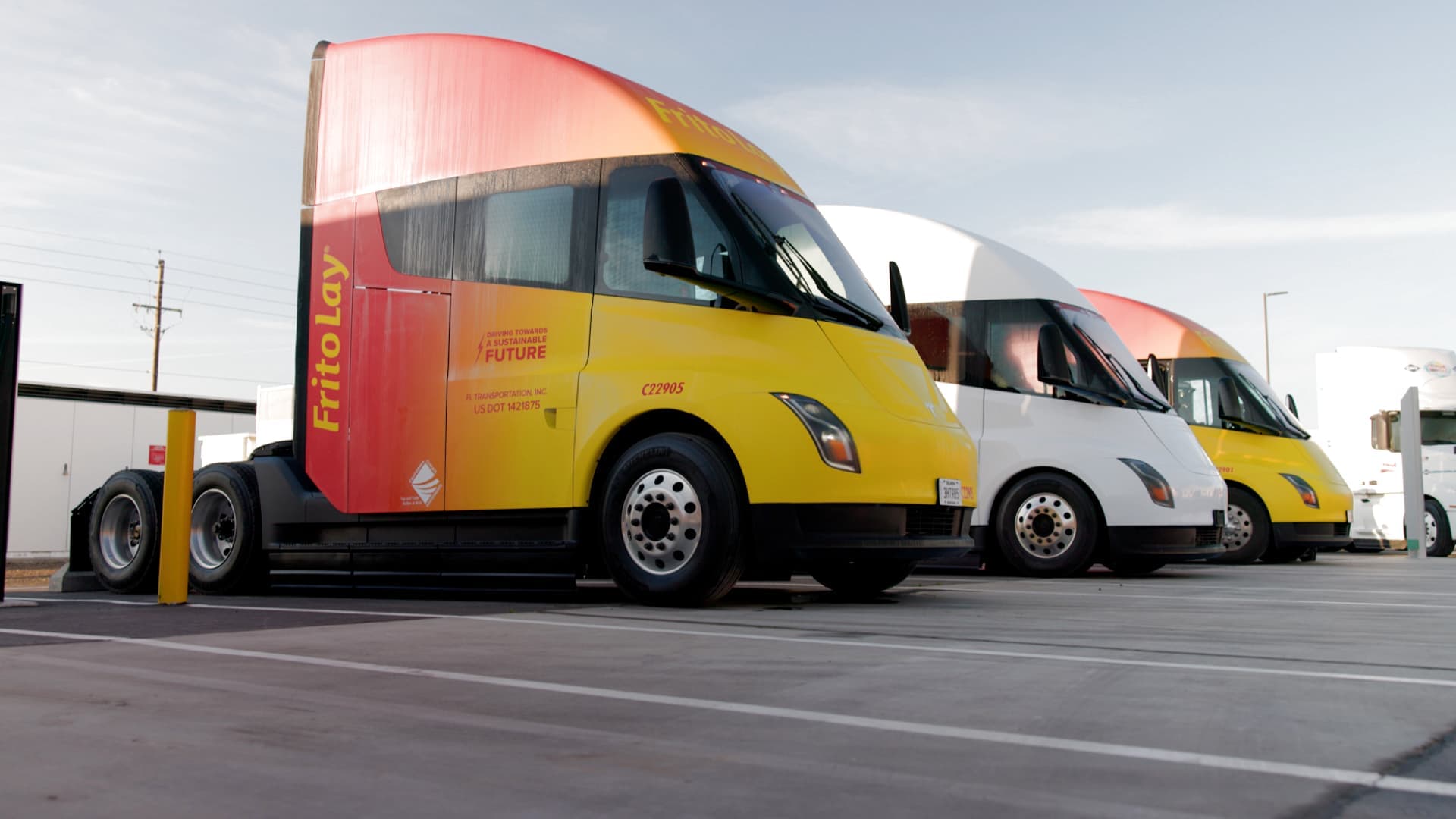
Then PepsiCo put 15 Tesla Semis on the same California routes as its diesel and natural gas trucks, and something interesting happened. One Semi ran 320.4 miles across 15 trips in a single 8.4-hour shift, without plugging in once.[1] That wasn’t an outlier. There were 139 days in the dataset where a Semi covered more than 250 miles.[1]
In the NACFE Run on Less test, the best-performing Tesla Semi averaged 574 miles in a single day. The Nikola Tre BEV managed 255. The Freightliner eCascadia, 181. The Volvo VNR Electric, 175.[2] It wasn’t close.
That puts the range debate to rest. The question now is how far ahead the Tesla Semi actually is, and what that means for fleet economics.
Head to Head
Tesla Semi vs. The Competition
Tesla finally locked in production specs in early 2026. Two variants: a Standard Range (325 miles) and a Long Range (500 miles), both running a tri-motor, 1,072-horsepower drivetrain that charges at 1.2 MW.[3] On paper, that’s a generation ahead of the competition. But let’s look at the actual numbers.
Note: Nikola restructured in 2025, but its BEV line remains in production and incentive-eligible.[12]
Tesla Semi LR
Nikola Tre BEV
Volvo VNR Electric
Freightliner eCascadia
Sources: Tesla.com (Feb 2026)[3], Electrek[9], Freightliner[10], Nikola Motor[8]. Tesla pricing from confirmed customer quotes[9]. *Competitor gross pricing is not publicly disclosed by most OEMs; the ICCT 2025 study found the median Class 8 BEV tractor price was $411,200.[11] Nikola figure from current dealer listings.[12] Heavy incentives (HVIP vouchers of $84k–$351k in California) can significantly reduce net cost for all trucks shown.[9]
Range Comparison (miles, fully loaded at 82,000 lbs GCW)
Tesla Semi Long Range offers double the range of the nearest affordable competitor
The Efficiency Edge
Using 3–4× Less Energy Than Diesel
This is where the math breaks open. The Semi uses three to four times less energy than a diesel truck to move the same load the same distance.[4] That’s not a marginal improvement. That’s a completely different cost structure.
The Frito-Lay deployment made it concrete. Running the same routes with the same loads, the Tesla Semi posted 19.6 miles per diesel gallon equivalent (MPDGE), 2.4 times more efficient than diesel and 2.2 times better than the natural gas trucks sitting right next to it in the fleet.[1] And the efficiency kept improving as drivers learned the truck, trending from 1.6 kWh/mile toward 1.4.[1]
Energy Efficiency: kWh per Mile (Lower Is Better)
Tesla Semi uses a fraction of the energy consumed by diesel and competing EVs
What does 1.64 kWh/mile actually mean? At average U.S. commercial electricity rates (~$0.08/kWh), that’s about $0.13 per mile in fuel cost. A diesel truck at 6.5 MPG paying $3.80/gallon spends $0.58 per mile. The Tesla Semi cuts fuel costs by about 78%.
Fuel Efficiency: Miles Per Diesel Gallon Equivalent (MPDGE)
From the Frito-Lay pilot program: identical routes, same loads, measured side by side[1]
Real-World Data
What Fleet Operators Are Actually Seeing
Specs only tell part of the story. The real test is what happens when you hand the keys to fleet operators and let them haul actual freight. Six companies have now put the Semi through real-world routes, and the pattern is consistent.
| Operator | Region / Routes | Miles | Efficiency | Key Detail |
|---|---|---|---|---|
| ArcBest (ABF Freight) | Varied, incl. Donner Pass (7,200 ft) | 4,494 | 1.55 kWh/mi | “Generally matched diesel counterparts”[4] |
| Mone Transport | Texas, U.S.–Mexico border | 4,700 | 1.64 kWh/mi | Cross-border freight operations[4] |
| PepsiCo / Frito-Lay | California regional | Ongoing | 1.6–1.7 kWh/mi | 15 Semis, 574 mi best single day, 19.6 MPDGE[1][4] |
| DHL Supply Chain | Livermore, CA (long-haul) | 3,000+ | 1.72 kWh/mi | 390-mile route at 75,000 lbs GCW[5] |
| Saia | LTL regional | Pilot | 1.73 kWh/mi | Less-than-truckload carrier[4] |
| RoadOne IntermodaLogistics | Oakland / Fremont, CA | Ongoing | 1.9 kWh/mi | 38,000 lb payloads, aluminum/steel coils[6] |
“Our pilot of the Tesla Semi exceeded expectations, proving its ability to efficiently haul a typical DHL freight over long distances on a single charge. With its range of up to 500 miles, the Semi unlocks opportunities that were previously beyond the limits of heavy-duty EVs.”
— Jim Monkmeyer, President of Transportation, DHL Supply Chain North America[5]
The consistency is the point. Whether it’s cross-border freight in Texas[4], a 7,200-foot climb over Donner Pass[4], or heavy industrial hauls in the Bay Area[6], the Semi delivers efficiency between 1.55 and 1.9 kWh per mile. That’s a level of predictability fleet managers can plan around.
Pilot Program Efficiency Results (kWh/mile)
Every operator beat or matched Tesla’s official 1.7 kWh/mi target. The red dashed line shows diesel’s energy equivalent at 5.5 kWh/mi.
RoadOne IntermodaLogistics, which has hauled components for Tesla since 2012, purchased its first Semi in January 2026 and plans to acquire up to 10 more for its Oakland operations. VP of Strategic Growth Alex Joyce noted the company is “in the works of bringing on more trucks to service more of our primary customers asking for these ESG/clean truck solutions.”[6]
Pricing & Total Cost of Ownership
For years, Tesla didn’t confirm Semi pricing. In February 2026, Electrek got an answer: the Long Range (500 miles) is $290,000 before destination fees and taxes, and the Standard Range (325 miles) is approximately $260,000 per California’s HVIP voucher data.[9]
That’s about 60% more than the $150,000/$180,000 Tesla quoted in 2017. But at $290,000, it’s still $145,000 below the industry average — CARB put the average zero-emission Class 8 at $435,000 in 2024.[9] The Semi also sits well below the ICCT’s 2025 median of $411,200 for Class 8 BEV tractors, with the longest range in the segment.[11]
California has set aside nearly $165 million in HVIP vouchers specifically for Tesla Semi purchases, covering about 992 vouchers worth between $84,000 and $351,000 each. Tesla has also partnered with Uber Freight to offer additional discounts through a fleet accelerator program, further reducing the effective purchase price for qualifying operators.[9]
But sticker price is only part of the picture. The Frito-Lay pilot program found that electric trucks are about one-third as costly to operate as diesel when accounting for fuel, maintenance, and insurance.[1] Zero oil changes, dramatically fewer brake replacements (thanks to regenerative braking), and no emissions system maintenance translate to significantly lower annual service bills.
The CalStart study modeled payback periods with available incentives and found the payback period is approximately 5.5 years against an 8-year operational life, with total savings of about $200,000 over that lifespan.[1] Electrek’s analysis tracks: at ~$0.18/kWh, the Semi’s ~$110,000 premium over a new diesel pays for itself in about 4 years on local distribution routes.[9]
Infrastructure
The Charging Equation
The biggest open question for fleet operators is charging. Tesla’s answer is twofold: depot charging for daily ops and a public Megacharger network for longer hauls.
The Semi charges via the Megawatt Charging System (MCS 3.2) standard at a peak rate of 1.2 MW (1,200 kW), reaching 60% state of charge in just 30 minutes.[3] For comparison, the Freightliner eCascadia and Volvo VNR Electric max out at 270 kW, meaning a 90-minute charge gets them to 80%.[2] That’s about a three-to-one speed advantage for the Tesla Semi.
Charging Speed: Max Power (kW) and Time to Usable Charge
Tesla's 1.2 MW Megacharger is in a different class from CCS-based competitors
For many fleets, depot charging is even more important than en-route charging. The Frito-Lay data showed that overnight charging was sufficient for the Semi’s daily 300-mile duty cycle, with an average charge session completing in 1.24 hours and delivering 313.3 kWh.[1] DHL’s Semi in Central California currently runs about 100 miles per day and only needs to charge about once per week.[5]
Tesla launched its first public Semi Megacharger site in Los Angeles in early 2026 and is actively building out a freight corridor network.[4] The Frito-Lay facility also demonstrated the power of integrated energy solutions: Tesla Solar, Tesla Battery Energy Storage (BESS), and Tesla Megachargers working together. At that site, solar production exceeded all energy consumed by the zero-emission vehicles combined.[1]
Peak shaving matters: The Frito-Lay study found that demand charges (fees utilities levy based on peak power draw) can constitute the majority of a site’s electricity costs. Tesla’s battery storage systems address this by slowly charging from the grid during off-peak hours and then powering chargers during peak demand.[1]
The Green Case
Environmental Impact at Scale
Freight accounts for about 25% of all transportation emissions in California.[1] Electrifying even a slice of the Class 8 fleet moves the needle.
The CalStart study quantified it. A single electric yard tractor offsets 23,570 kg of CO₂, 93.8 kg of NOₓ, and 850 grams of particulate matter per year over 2,500 service hours.[1] That’s the equivalent of pulling 5.2 gas cars off the road, per truck, per year.
DHL projects each Tesla Semi in its fleet will reduce greenhouse gas emissions by 50 metric tons annually.[5] At that rate, a 100-truck fleet would eliminate 5,000 metric tons of CO₂ per year, before accounting for any renewable energy integration at the depot.
Scaling the Impact: Annual CO₂ Reduction by Fleet Size
Based on DHL’s projection of 50 metric tons CO₂ reduced per Tesla Semi per year[5]
Driver experience backs it up. In the Frito-Lay pilot, 80% of drivers reported that operating the Tesla Semi was similar to or an improvement over diesel tractors.[1] Nearly all operators found the ZE Semi to be a better alternative than both the baseline diesel and the new RNG tractors. Time spent charging, they said, impacted their daily schedule about the same as fueling a diesel truck.[1]
Looking Ahead
Production Ramps in 2026
The Semi has been a slow burn. Low-volume production started in late 2022, limited to a handful of PepsiCo trucks. Since then, Walmart, DHL, Saia, ArcBest, RoadOne, and Mone Transport have all gotten their units. But 2026 is where the story changes.
In February 2026, Elon Musk confirmed on X: “Tesla Semi starts high volume production this year.”[3] Tesla’s updated Semi webpage reads “Deliveries start in 2026,” and the truck received a design facelift in November 2025 that aligns it with Tesla’s current design language.[3] Both variants are described as “designed for autonomy.”[9] As of March 2026, the dedicated Tesla Semi factory is nearing completion, with mass production ramp targeted for mid-2026 and eventual capacity of up to 50,000 units per year.[13]
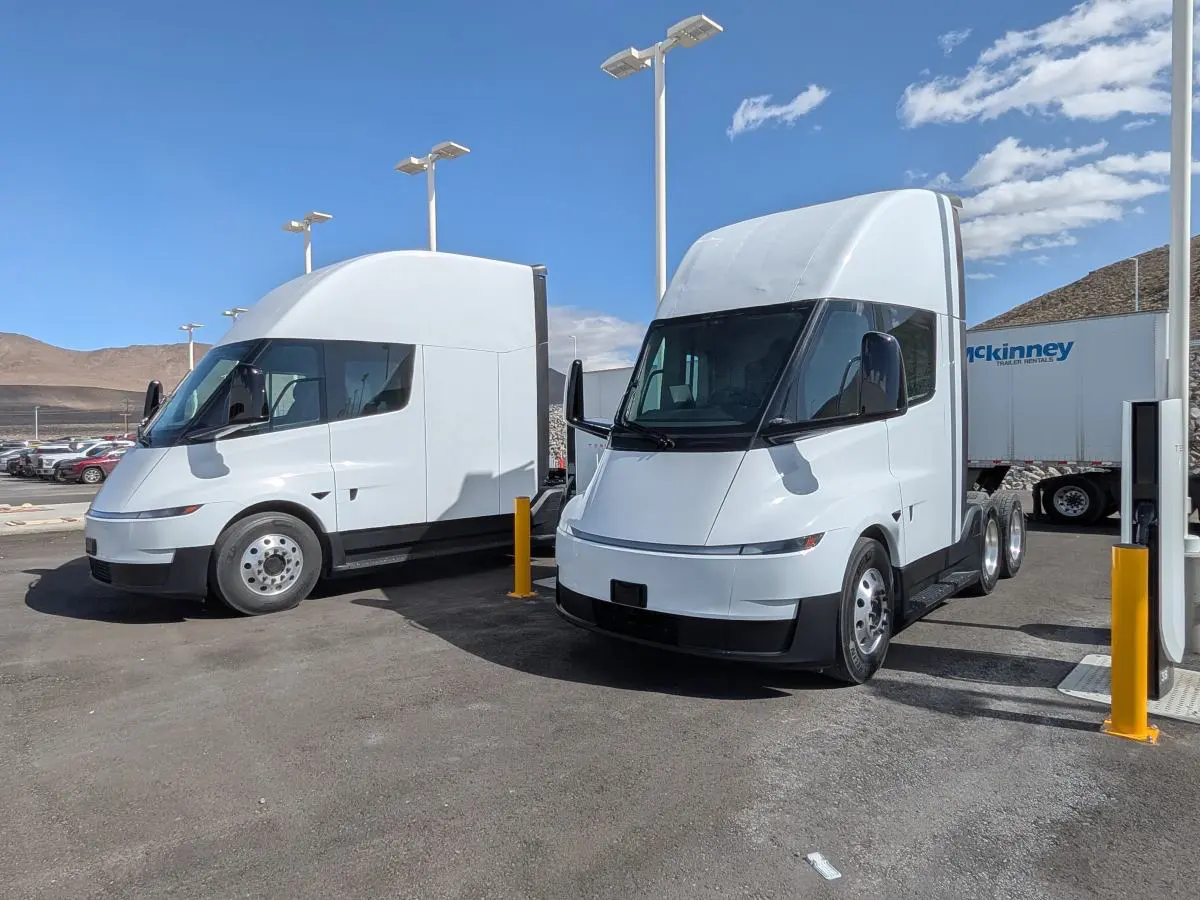
DHL has publicly stated it plans to add more Semis in 2026 as volume production begins.[5] RoadOne is scaling from 1 to up to 10 trucks.[6] As Dan Priestley, Tesla’s Director of Semi, put it: “Their experience as a trusted logistics provider will help us make the product even better for future global markets.”[5]
The shift from pilot to production means better pricing, wider availability, and a denser Megacharger network. For fleet operators still on the fence, the pilot data is in. The numbers are clear.
Download the full report as PDF